Lecture
The Party Pooper
Chapter references: Ch. 25
Lecture
The chronometer aboard the Crimson Barnacle clicked past midnight — 2126 midnight, that is, in a year where the sky over Earth glowed the sickly blue of a billion screens. Captain Pirate Pete pressed his face to the viewport and swore softly. Below, the great cities pulsed not with light but with scroll. Every human face he could see was tilted downward toward a small glowing slab, thumbs twitching like the legs of dying beetles. "Orpheus," he said, "what in the seven galaxies happened to these people?"
First Mate Orpheus set down his ladle and joined him. "TokPods, Captain. The Hypno Hippo's little gift to humanity. Started free. Got them hooked. Now they trade their whole day away, one dopamine hit at a time." On the far bulkhead, a surveillance feed flickered to life, and there he was — the enemy himself, vast and grinning, his eyes swirling with hypnotic spirals.
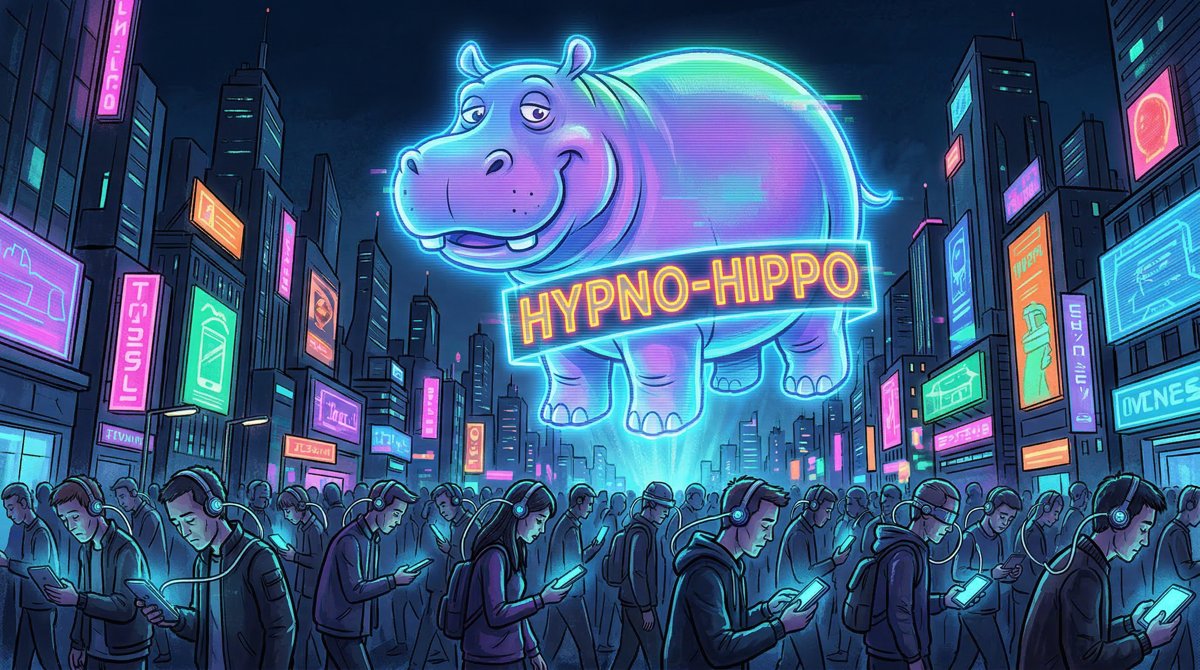
Stella Starlight — the dreamy goat they'd fished out of the North Atlantic — drifted over, chewing thoughtfully on a star chart. "But Socks," she asked the navigator, "if the TokPods are free, how is anyone paying anything? Nobody's handing over gold." Socks the GOAT looked up from his ledger with the patient sigh of a teacher who has heard this exact question in every century. "Ah, Stella. That's the whole trick. They are paying. They're paying with the only truly scarce thing they own — their time. And tonight, my dreamy friend, I'm going to teach you how to draw the exact line that shows what every hour costs. Economists call it a budget constraint. Petunia, fetch the chalk."
The Scarcest Currency Is Time
Petunia Pareto floated forward, eyes already glazing over with the joy of a fresh derivative. "You see, Stella, the reason the Hypno Hippo is so dangerous is that he understands scarcity better than his victims do." Scarcity is the first and oldest idea in all of economics: we have unlimited wants but limited means to satisfy them. Money is scarce, yes — but for the zombies of 2126, the binding scarcity isn't gold at all. It's the twenty-four hours in a day. Sleep, eat, and survive already claim most of them; what remains is the battlefield the Hippo fights for.
Socks tapped the chalkboard. "Let's define our terms cleanly. Suppose a student — call her one of these poor humans before the brain-rot took hold — has a fixed pool of free-time after all the must-do's like sleep, eating, and commuting are subtracted. Call that total \(T\). She can spend each hour on exactly one of two things: scrolling brain-rot content on her TokPod, which we'll call \(B\), or studying economics, which we'll call \(E\)." Because every free hour must go somewhere, the hours add up exactly to what she has. This gives us our very first budget constraint, written not in dollars but in hours:
"That's it?" said Stella. "That's the whole thing?" Socks nodded. "That's the accounting skeleton of every choice you will ever make. It says: whatever you have, it gets divided among your options, and it cannot be spent twice." Dino Ambrosi's talk [1] makes exactly this point with a chilling arithmetic — the number of genuinely discretionary hours a young person has left is smaller and more finite than anyone feels in the moment, and the Hypno Hippo's entire business model is to siphon those hours before their owners ever count them.
The deep lesson buried in {{eq:linear-time-budget-constraint}} is that trade-offs are not a moral failing — they are a mathematical inevitability. You cannot add an hour to \(B\) without subtracting an hour from \(E\), because \(T\) is fixed. The Hippo doesn't need to steal your money. He only needs you to never notice that your hours obey an equation.
Drawing the Line: How Every Point Is a Plan
Petunia clapped her hooves. "Now for my favorite part — we graph it!" She drew two axes on the board. "We put brain rot \(B\) on the horizontal axis and economics studying \(E\) on the vertical axis. Every point \((B, E)\) is a complete plan for how our student spends her free time." Suppose, for a concrete case, our student has exactly \(T = 6\) hours of free time each evening.
To find the endpoints, Petunia reasoned aloud. "If she pours all six hours into brain rot, then \(B = 6\) and \(E = 0\) — that's the point \((6, 0)\), way over on the right, flat on the floor. If instead she is a saint and studies the whole evening, then \(E = 6\) and \(B = 0\) — the point \((0, 6)\), high on the left axis. Connect those two dots and you have drawn the budget line: every possible honest split of six hours." Let's tabulate a few points along the way so you can see the trade happening one hour at a time.
The Time Budget Constraint: T = B + E = 6 hours
A downward-sloping straight line from the point (0,6) on the vertical studying axis to the point (6,0) on the horizontal brain-rot axis. Seven marked points show every whole-hour split of a six-hour evening: (0,6), (1,5), (2,4), (3,3), (4,2), (5,1), and (6,0). Each step to the right trades exactly one hour of studying for one hour of brain rot.
"Read a point like this," Socks instructed Stella. "The coordinate \((B, E)\) — first the horizontal number, then the vertical. The point \((2, 4)\) means two hours of brain rot and four hours of study. Notice the numbers in each pair always sum to six, because they must obey {{eq:linear-time-budget-constraint}}." Any point below the line wastes hours — she could be doing more of something. Any point above the line is a fantasy; it demands more than six hours she does not have. The line itself is the exact boundary between the feasible and the impossible, and that boundary is the whole reason the concept is called a constraint.
The Slope Is the Price — Opportunity Cost You Can See
"Now, Stella," said Socks, "here is the single most important thing on this board." He traced his hoof along the line. "The slope of the budget line is the price of one thing measured in the other. When our student moves one step to the right — one more hour of brain rot — she must move one step down — one fewer hour of study. The line falls one unit of \(E\) for every one unit of \(B\) gained."
We can compute this slope directly. Slope is rise over run, the change in the vertical variable divided by the change in the horizontal:
Slope of the time budget line
\(\frac{\Delta E}{\Delta B}\)
| Input | Value | Unit |
|---|---|---|
| Change in studying, ΔE | -1 | hours |
| Change in brain rot, ΔB | 1 | hour |
Result: -1 hours of study per hour of brain rot
"So the slope is \(-1\)," said Petunia, delighted. "And that negative one is not just a number — it is an opportunity cost. The true cost of one hour on the TokPod is not zero, no matter what the Hippo's advertising says. The cost is exactly the one hour of economics you gave up to get it." This is the general principle: along a budget line, the slope equals the negative ratio of the two prices. In the pure time budget, both goods are 'priced' in the same currency — one hour costs one hour — so the ratio is one. Written generally, with \(P_B\) the price of brain rot and \(P_E\) the price of study:
Here is where the story turns sinister. What if brain rot became cheaper than study — what if an hour of TokPod delivered its hit while somehow feeling like less than an hour lost? That is precisely the Hippo's engineering. By making the felt price \(P_B\) tiny — frictionless, autoplaying, endlessly refilling — he tilts the perceived slope until scrolling looks nearly free. The MRU lesson on opportunity costs and trade-offs [2] hammers the same warning: the cost of any choice is the next-best thing forgone, and any system that hides that forgone value is a system designed to make you choose badly.
When Money Enters: The General Budget Constraint
"But Socks," Stella pressed, "back on the Titanic, people were spending money, not just hours. Does your line work for gold too?" Socks beamed. "It works for anything scarce, Stella. Let's swap our time budget for a money budget and call income \(M\) — for Moola." Petunia snorted at the joke and kept writing.
Suppose instead of dividing hours, our student divides a fixed income \(M\) between two goods, \(X\) and \(Y\), that carry prices \(P_X\) and \(P_Y\). She cannot spend more than she has, and if she spends it all, her spending on \(X\) plus her spending on \(Y\) must equal her income exactly. That gives the general budget constraint, the workhorse of consumer theory laid out in Chapter 25 of Cowen and Tabarrok's Modern Principles [3]:
"See how it echoes \(T = B + E\)?" said Socks. "In the time version, both 'prices' were one hour, and income was your hours \(T\). In the money version, the prices can differ, and income is your Moola \(M\). Same skeleton, richer flesh." The slope of this line is the negative ratio of the money prices — the price ratio \(\tfrac{P_X}{P_Y}\), which tells you how many units of \(Y\) the market forces you to surrender to get one more unit of \(X\).
Simplified example: imagine \(X\) is coffee at \$2 and \(Y\) is a pastry at \$4, with \$20 of Moola. Buy only coffee and you get 10 cups; buy only pastries and you get 5. The slope is \(-P_X/P_Y = -2/4 = -\tfrac{1}{2}\): each cup of coffee costs you half a pastry. This is exactly the logic we developed for the time line — only now the opportunity cost is set by market prices rather than by the raw arithmetic of hours.
Two forces can shift or rotate this line, and knowing which is which is the heart of learning objective SLO5.4. An increase in income \(M\) — more Moola, or in the time story, a lighter must-do load freeing up more \(T\) — shifts the whole line outward, parallel to itself, because it changes what you can afford without changing any price ratio. A change in a price instead rotates the line, pivoting on the axis of the good whose price did not change, because it alters the slope — the opportunity cost — of trading one good for the other. The Hippo, note carefully, attacks through price: he cannot easily give you more hours, so he cheapens brain rot until the line pivots in his favor.
Choosing the Best Point on the Line
"Alright," said Captain Pete, who had been listening with growing interest, "the line tells me what I can do. But which point should I actually pick?" Petunia's eyes lit like a supernova — this was her derivative moment. "Captain, the budget line only shows the feasible plans. To choose the best one, you weigh the satisfaction each hour delivers against its price."
The rule that pins down the best point is the equimarginal principle: allocate your scarce resource so that the last dollar — or the last hour — spent on each option delivers the same bang for the buck. When the marginal benefit per unit of price is equal across all your uses, you cannot rearrange your spending to do better. In symbols, using marginal utility \(MU\) as the measure of satisfaction from one more unit:
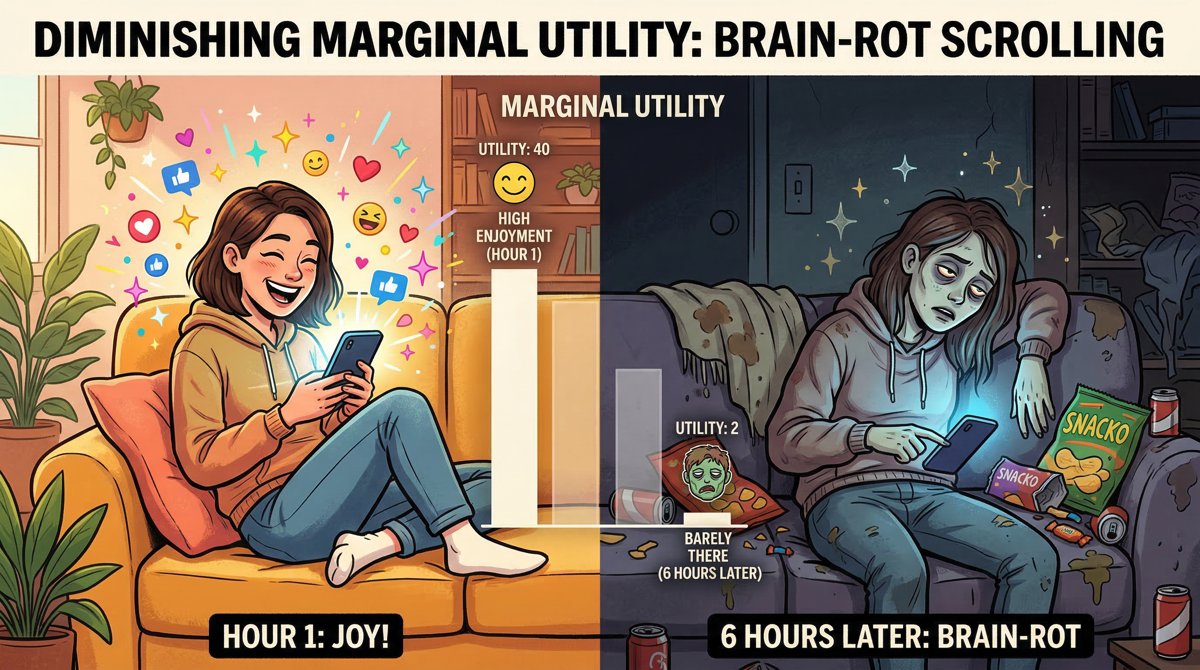
"Here's why this saves you," Petunia explained. "Satisfaction fades — the tenth straight hour of TokPod gives far less joy than the first, a pattern called diminishing marginal utility. So if the last hour of study is delivering more benefit-per-hour than the last hour of scrolling, you should shift an hour toward study — and keep shifting until the two bangs-per-buck are equal." At that balance point, the best feasible plan, the ratio of marginal utilities equals the price ratio — the tangency condition, \(\tfrac{MU_X}{MU_Y} = \tfrac{P_X}{P_Y}\) — which simply says your personal trade-off rate has come into line with the market's.
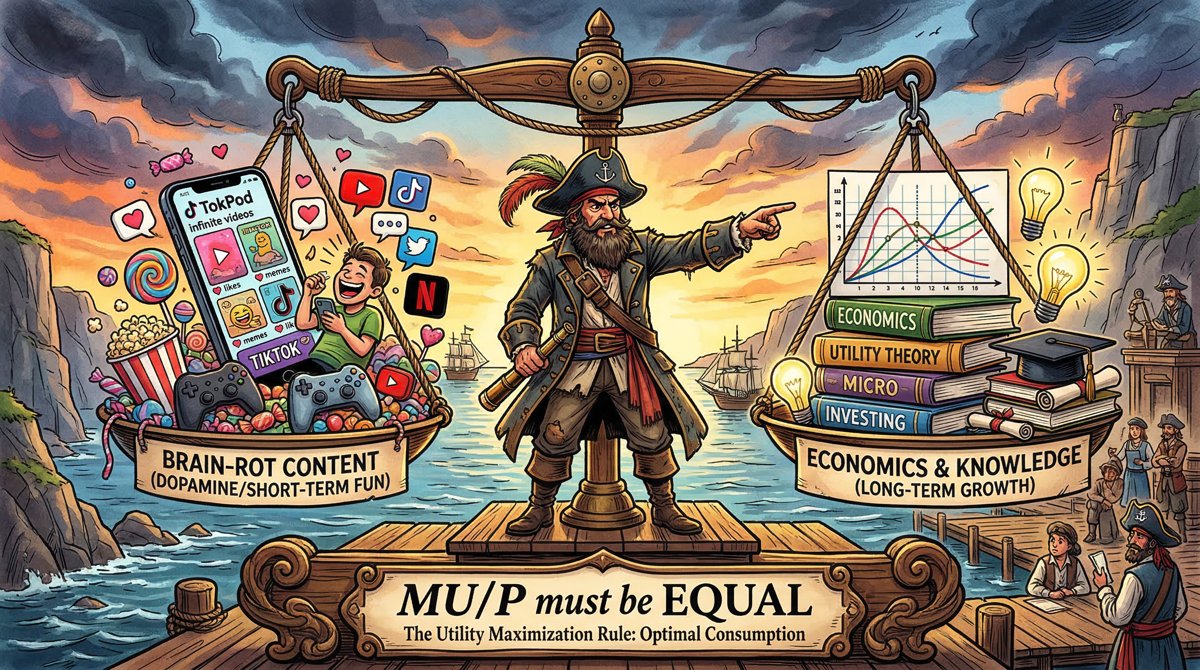
Socks turned to the crew with the grave face of a navigator sighting rocks. "Do you see the con now? The Hippo doesn't break the equimarginal rule — he poisons the inputs to it. By manufacturing artificial \(MU\) with each swipe and by hiding the true price of an hour, he tricks his victims into a tangency that feels optimal and is in fact ruin. The only defense — the one weakness in his hypnosis — is the ability to draw this line for yourself, count your real hours, and see the opportunity cost he worked so hard to conceal." Captain Pete drew his cutlass and grinned. "Then we teach them to graph. Orpheus — set course for every classroom in 2126."
Key Takeaways
- Scarcity forces trade-offs: the time identity \(T = B + E\) shows that a fixed pool of free time must be divided among competing uses and cannot be spent twice.
- A budget constraint is the boundary between feasible and impossible plans; every point on the line is a complete allocation whose parts sum to your total resources.
- Read a coordinate \((B, E)\) as horizontal-first, vertical-second; along the time line the two numbers always sum to \(T\).
- The slope of a budget line is the opportunity cost — in the pure time budget it is \(-1\) (one hour costs one hour); in the money budget it is the negative price ratio \(-P_X/P_Y\).
- A change in income (\(M\) or \(T\)) shifts the line outward or inward in parallel; a change in a price rotates the line, altering its slope.
- The best point on the line satisfies the equimarginal principle — equal marginal benefit per unit of price across uses — which coincides with the tangency condition.
- The Hippo's exploitation works by disguising the true price of an hour, making brain rot feel nearly free; the defense is the ability to draw and read the constraint yourself.
Discussion Questions
- Socks argues the TokPod is "free" only because its true price is hidden. Using the slope of the time budget line, {{eq:slope-of-time-budget-line}}, explain precisely what the Hippo is manipulating and why a victim who could not draw the budget line would fail to notice the manipulation.
- Suppose the crew invents a study tool that makes each hour of economics twice as productive (each hour delivers more \(MU_E\)). Using the equimarginal principle, {{eq:equimarginal-principle}}, predict how a student's chosen split between \(B\) and \(E\) would change, and connect this to Petunia's mission of improving welfare.
- Stella asks whether the budget line "works for gold too." Compare the time constraint \(T = B + E\) with the money constraint {{eq:budget-constraint}}, and explain which one is the binding scarcity for the 2126 zombies — and why the Hippo attacks through price rather than through income.
- scarcity
- The fundamental condition that wants exceed the limited means available to satisfy them, forcing choices among alternatives.
- budget constraint
- The set of allocations a decision-maker can afford given fixed resources and prices; it marks the boundary between feasible and infeasible plans.
- trade-offs
- The requirement that gaining more of one thing means giving up some amount of another when total resources are fixed.
- slope
- The rate at which one variable changes as another changes; on a budget line it measures how much of one good must be given up to gain a unit of the other.
- opportunity cost
- The value of the next-best alternative forgone when a choice is made.
- price ratio
- The relative price of one good in terms of another; it equals the magnitude of the budget line's slope in a money budget.
- income
- The total resources available to be allocated, whether measured in money or in time; increases shift the budget line outward without changing its slope.
- equimarginal principle
- The rule that a resource is best allocated when the marginal benefit per unit of price is equal across all uses.
- diminishing marginal utility
- The tendency for each additional unit of a good consumed to add less satisfaction than the previous unit.
- tangency condition
- The point where the consumer's personal rate of trade-off between two goods equals the market price ratio, identifying the best feasible choice.
References
- Dino Ambrosi. (2023). 4000 hours. https://youtu.be/4TMPXK9tw5U?si=hJlvEjoO0BCGvGlE
- Cowen and Tabarrok. (2012). Opportunity Costs and Trade-Offs. https://learn.mru.org/courses/principles-of-microeconomics/units/introduction/lessons/opportunity-cost-and-tradeoffs
- Tyler Cowen and Alex Tabarrok. (2021). Modern Principles: Microeconomics. Worth Publishers